
Is IPTV Legal in Ireland?
“IPTV” simply means television delivered over an internet connection. The technology is legal in Ireland and is used every day by licensed services — RTÉ Player, Virgin Media’s TV platform, eir TV and many others all deliver TV over IP. Whether a particular IPTV service is legal depends on one thing: does it have the rights to the channels and content it distributes?
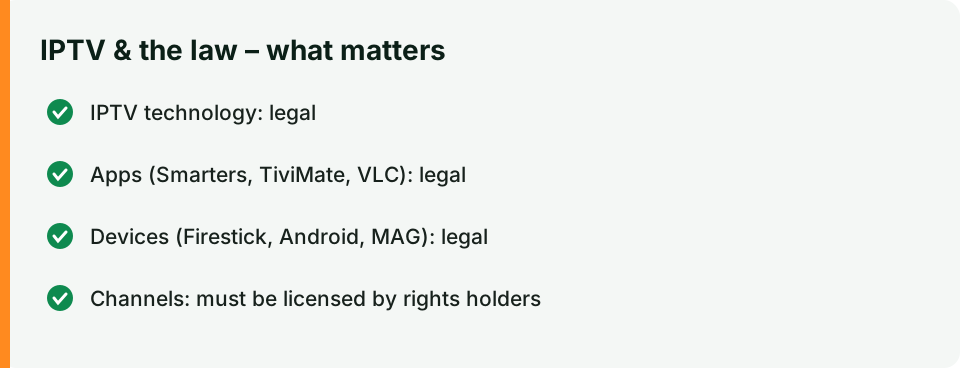
This guide explains the rules in plain language. It is general information, not legal advice.
Technology vs. content
| Legal? | |
|---|---|
| Watching TV over the internet (IPTV technology) | Yes |
| IPTV apps and players (IPTV Smarters, TiviMate, VLC…) | Yes – they contain no channels |
| Devices (Firestick, Android box, MAG) | Yes |
| Free official apps (RTÉ Player, TG4 Player, Virgin Media Play) | Yes |
| A subscription that resells channels without the rights holders’ permission | No – this infringes copyright |
The apps and devices are just tools. The legal question is always about the source of the channels.
What the law says
- Copyright. In Ireland, broadcasts and films are protected by the Copyright and Related Rights Act 2000. Making them available to the public without permission infringes the rights of broadcasters and rights holders.
- EU case law. In 2017 the Court of Justice of the EU ruled (case Stichting Brein v Wullems, “Filmspeler”) that selling devices pre-loaded with links to unlicensed streams is illegal, and that streaming from an obviously unlicensed source is not covered by the copyright exception for temporary copies. That means viewers, not only sellers, can be exposed.
- Blocking orders. The Irish High Court has granted rights holders — including sports organisations — orders requiring Irish internet providers to block servers that stream unlicensed content, including during live matches.
- Enforcement. Rights holders and Gardaí have taken action against people selling unlicensed IPTV in Ireland, and EU-wide operations have shut down large services.
In practice, enforcement has focused on sellers and distributors, but the legal position for viewers is not risk-free.
How to check whether an IPTV service is licensed
Ask these questions before paying:
- Does the company say who it is? A registered business name, address and contact details are a basic sign of legitimacy.
- Does it state its licences? Licensed services can tell you which channels they carry and under what agreement.
- Is the price realistic? Premium sport and film channels cost broadcasters a great deal. Thousands of premium channels for a few euro a month is a warning sign.
- How do you pay? Card payments with a clear merchant name offer buyer protection; gift cards and crypto-only payments do not.
- Is there a refund policy and terms of service?
Read more in our checklist on how to choose an IPTV provider in Ireland.
Geo-blocking and IP restrictions
Some content is only licensed for a specific country. Official services such as RTÉ Player or BBC iPlayer check your location and may block or limit content outside their licensed area. EU rules on cross-border portability allow you to use your paid subscriptions from your home country while temporarily travelling in another EU country.
Using a VPN for privacy is legal in Ireland. Using one to get around the licensing terms of a service may break that service’s terms of use.
What you need to know in 60 seconds
IPTV stands for internet protocol television: TV delivered over a broadband connection rather than a satellite dish, aerial or cable. Here is what matters legally for individual viewers in Ireland:
- The technology is completely legal. Internet protocol television is used by fully licensed broadcasters and service providers every day.
- Player apps are legal. An IPTV player app such as IPTV Smarters, TiviMate or VLC contains no channels — it only plays the streams you add.
- The source of the channels is what counts. Legal IPTV comes from services that hold the rights to every channel they carry; unlicensed services resell channels without permission.
- Streaming services and broadcaster apps (RTÉ Player, TG4 Player, Virgin Media Play) are a popular choice for Irish channels and are always licensed.
- Payment matters too. Paying with card details through a clear merchant gives you protection that crypto or gift-card payments don’t.
Before you buy, look for a full channel list, a named company and written terms. A good IPTV experience is not worth much if the service disappears overnight, so check how IPTV services describe their licensing before you start IPTV streaming.
What this means for you
- Using IPTV technology, apps and devices is legal.
- Watching licensed channels over IPTV is legal.
- Paying for a service that redistributes channels without permission carries legal risk, and the service can disappear without warning when servers are blocked or seized.
- You still need a TV licence if you have a television set in Ireland.
If you are unsure about a specific service, ask the provider directly — and if you need certainty for your situation, speak to a solicitor.